


Stealth Taper #3–4: fly lines for finesse, stealth and versatility

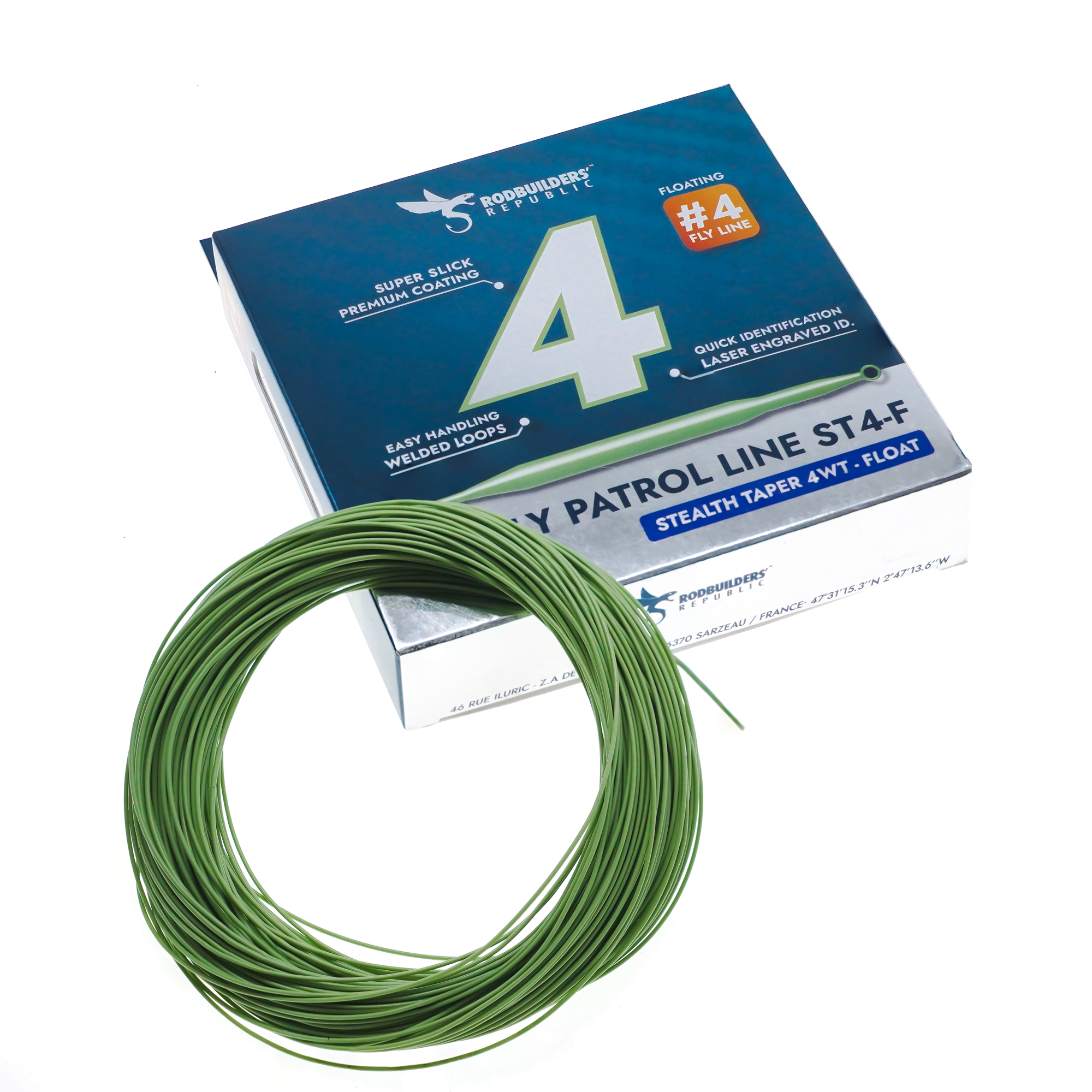
The Fly Patrol Lines fly lines are available in Stealth Taper profiles in sizes 3 and 4, designed for delicate freshwater fishing, mainly dry fly or sight nymphing. They best embody the spirit of finesse inherent to fly fishing: the delicacy of presentations, the drift of a tiny mayfly tied on a H18 hook all the way to the steady rise of a trout we hope is a pretty one.
These lines are made for mild conditions and are used with very light outfits. In a word, it’s when fly fishing reaches the height of its poetry and serenity.

To illustrate the strengths of our Stealth Taper No. 3 and No. 4 lines, we first invite you for a short stroll along the water. If you recognize yourself in one of these situations—a spot you fish—then a Stealth Taper is made for you. Then we’ll lift the hood to explain our technical choices, and you’ll see what you can expect when spooling an ST3 or an ST4 on your favorite rod.
Design brief
Here are three scenarios that will give you an idea of the situations for which the ST3 and ST4 are best suited. It’s both a walk along the water and the design brief that guided our technical choices when designing these lines.
Scenario 1: Rising fish on the Aa at Renty
Although it’s a small coastal river (well known to crossword aficionados), the Aa is a watercourse whose upper section, designated first category, looks for all the world like a chalkstream winding lazily through pastures. This stretch holds a population of wild salmonids—brown trout and grayling—whose finest specimens easily approach 40 cm.
Fishing there is generally a matter of precision and delicacy. The fish become quite wary as the season progresses, so you usually get only one or two passes when trout are feeding on top. You rarely fish farther than about a dozen meters on this waterway.
On the fine days of May and June, with a 9-foot rod, a 4-weight line with a fine tip allows truly delicate presentations and silent pick-ups. This is postcard dry-fly fishing: the softness of evening, insects on the wing, and the joy of seeing your little caddis disappear in a swirl…

Scenario 2: System change on the Nive at Baigorri
Legendary rivers of the Basque Country, the Nives are fed by abundant rainfall that sustains the region’s sumptuous palette of greens. They remain wild and still hold superb brown trout, whose largest specimens would be worthy of a fishing magazine cover.
The Nive in the Baigorri valley is not very wide. Its flow there is a bit slower than in the upper reaches, which lends itself well to systematic exploration with light contact nymphing. But sooner or later, the trout lift their noses for a hatch: that’s the moment to switch to dry! A 3-weight line, fine at the tip and without excess weight, will pair perfectly with a NaF tight-line nymphing rod, to switch instantly to dry-fly mode as soon as the rises begin.

Scenario 3: Spey on the upper Scorff
Another coastal river in Morbihan, the Scorff is generously fed by Breton rain and flows through inland Brittany to the Lorient roadstead, where it joins the Blavet. On its upper course, the Scorff offers stretches often heavily overgrown with riparian vegetation (ripisylve). Magnificent golden-hued brown trout reward those who can outsmart low branches and lay the leader precisely under or behind an obstacle.
In these conditions, two technical assets are essential. First, you must excel at roll and spey casting to fish effectively despite the lack of space behind or above you. For these casts, it is preferable to use a line whose head profile is shifted toward the rear, with a very fine tip and the main mass of the head concentrated toward the back of the line.
The other valuable asset is mastery of Italian casting (TLT technique). This casting style lets you slip under vegetation without spooking fish, or curve around a rock by laying the leader at a right angle to the line. An efficient TLT setup includes a powerful 7’6” rod and a light 3-weight line, i.e., perfectly calibrated to the AFTMA standard.

Design philosophy
ST3 and ST4 follow the same design principles, which can be summed up as: stealth, aptitude for delicate fishing, and casting versatility (both aerial and roll/spey).
Head profile: Stealth Taper means a discreet profile, and that’s the central idea behind these lines. The tip is extremely fine, therefore very light. This choice has two consequences: on the one hand, it facilitates ultra-gentle presentations, and on the other, it ensures excellent energy transfer to leaders with a relatively fine butt section.
The main mass of the line’s head is shifted toward the rear of the profile (Weight Forward configuration). This clearly facilitates roll and spey casts. Finally, the 10,50 m head length lets you comfortably extend your shoot if necessary, without ending up prematurely on the backing.
Core: The line core is relatively thin (~24 lb strength) and shows fairly low stretch (around 9%). In use, this translates into virtually no memory and efficient strike transmission, even at distance.
Coating: The coating of the ST3 and ST4 is the same as on our LST #5, #6 and #7 lines. It’s a very high-quality PVC coating, offering slickness that’s immediately perceptible to anyone holding the line. The slickness is a real pleasure: the line shoots through the guides, the loop extends effortlessly, and you can gently reach a distant rise. What’s more, the line has no memory: even after prolonged storage, it unrolls supple and straight, without unwanted twist or coil.
Usage tips
A few recommended rod & line combinations to exploit the full potential of the Stealth Taper..
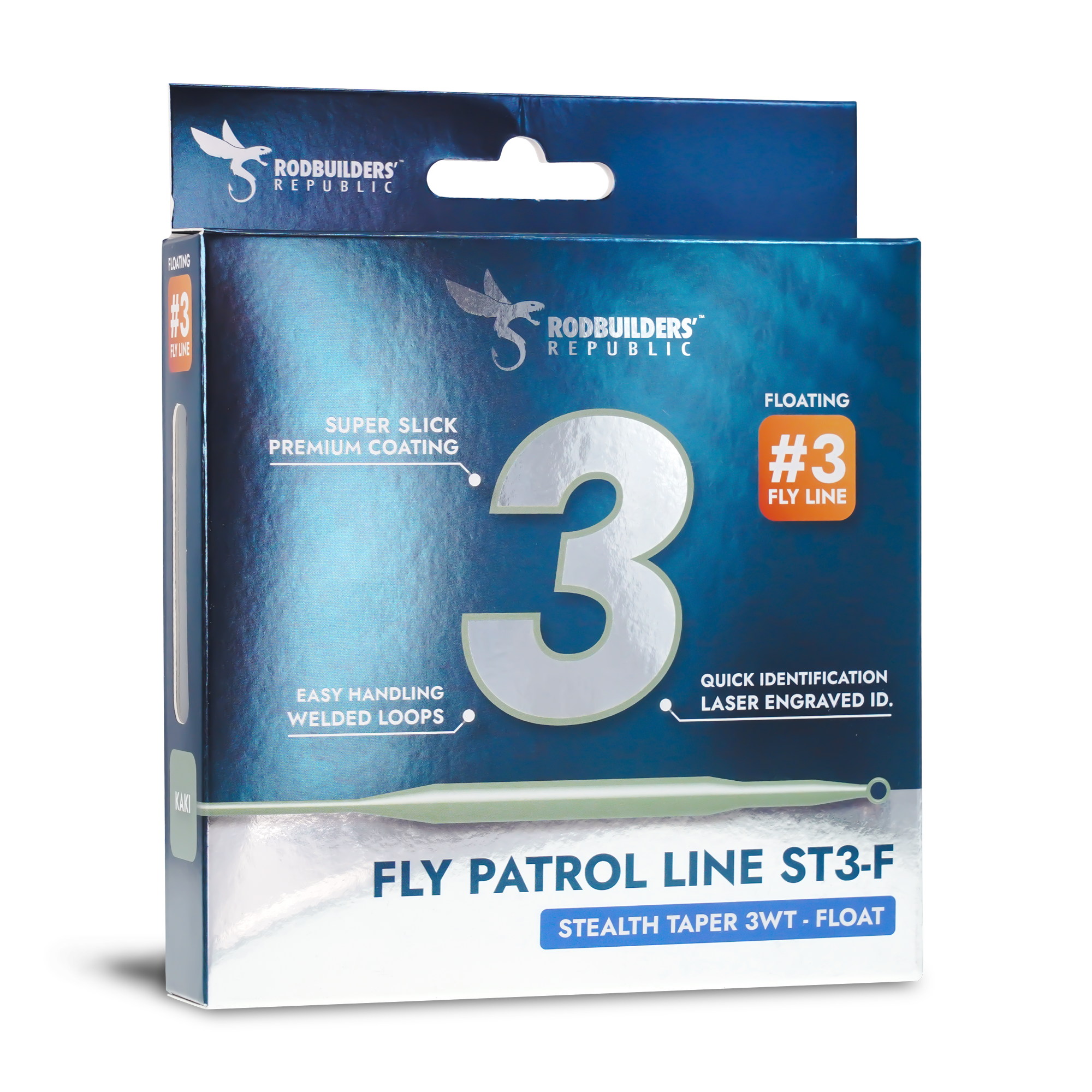
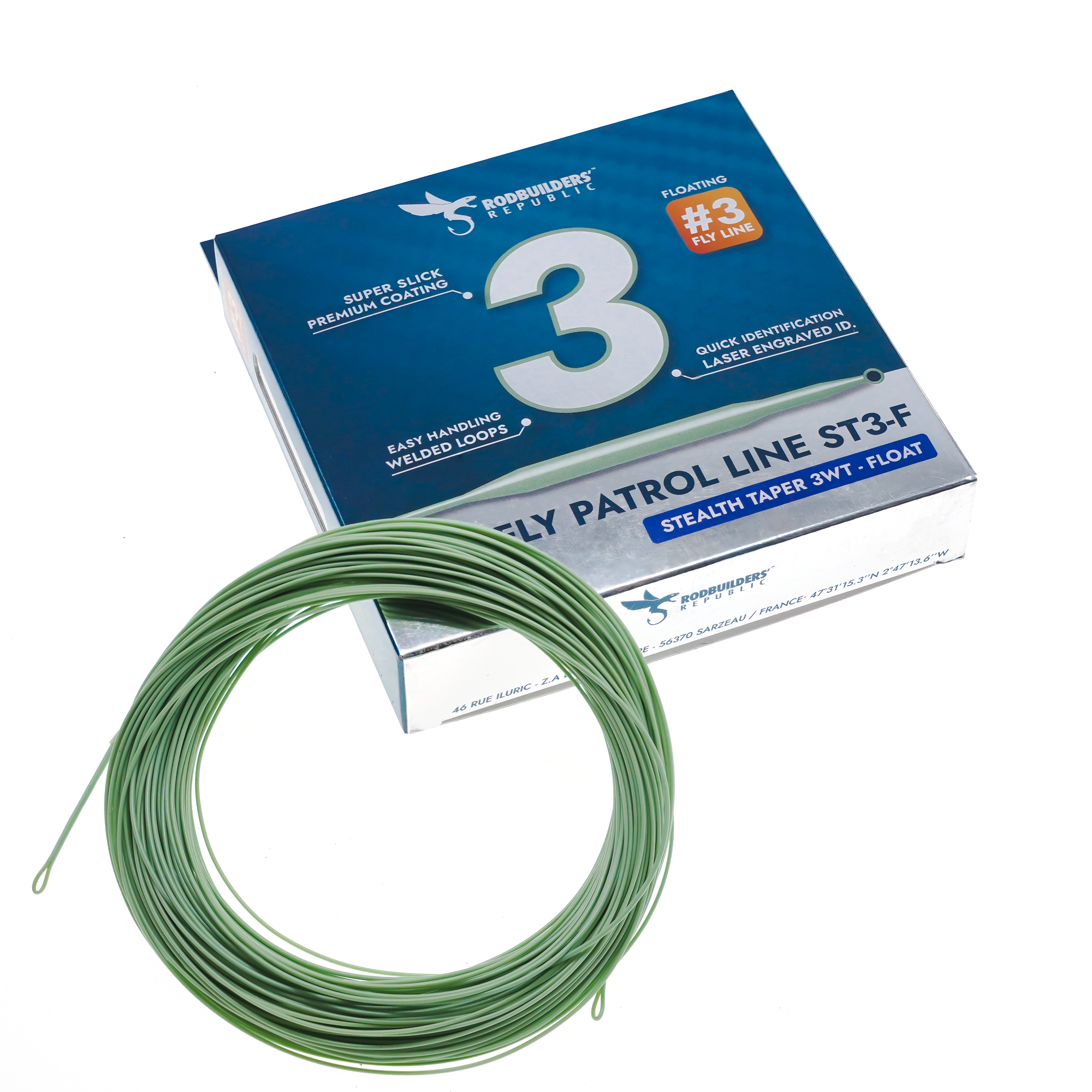
Regarding the Fly Patrol Lines ST3-F line, here are our recommended blanks:
- LH 763: perfect for short, delicate fishing; it’s a joy for sight-fishing rudd in summer. The ultimate finesse outfit.
- FAF 763: this powerful blank excels for Italian casting techniques. Angolato (to land the fly before the line), under-tip casting (to skim the line right over the water under branches), or the famous svirgolato (to impart devilish rightward curves)… With an ST3, this combo proves ultra-capable.
- LH 1062: this rod that shines in light tight-line nymphing will also propel an ST3 with control and precision toward surprise rises. Its ability to control the line’s drift is excellent.
- FANY 1101: likewise, this 11-foot competition rod pairs perfectly for subtle presentations and precise long-range drift control.
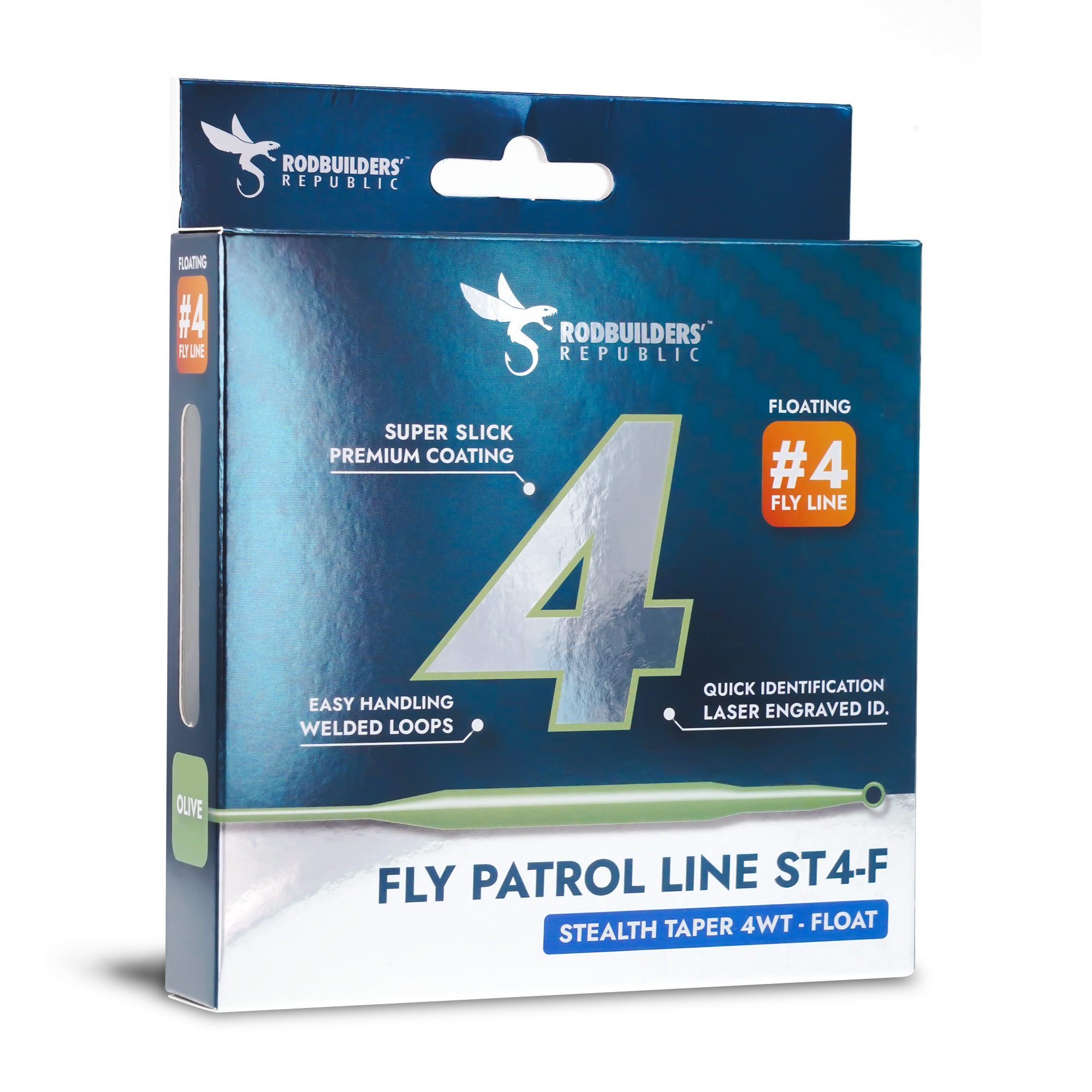
Regarding the Fly Patrol Lines ST4-F line, here are our recommended blanks:
- LH 904: an absolutely perfect combination for all delicate river fishing. It’s versatility incarnate: whether you’re dropping a small olive fly (BWO type) on the nose of a brown trout at 6 m, tempting a cruising chub with a grasshopper, or executing a switch cast at 15 m toward a grayling mid-flat… The LH 904 paired with the ST4 excels in all these fishing situations.
- TR74: the secret gem for Italian casting (TLT). This blank, initially designed for rockfishing, allows exceptional loop control—especially at high speed—and provides an authority in casting found nowhere else. Its solid carbon tip is also excellent insurance against hook pulls in the fight. The perfect match with an ST4.
- INV 763: fiberglass rods often appreciate a slightly heavier line. We therefore recommend pairing our little Invader 7'6" (fiberglass) with an ST4 to tackle any situation on small to medium rivers. You’ll enjoy the inimitable feel of fiberglass and its excellent fighting performance. A pure-pleasure outfit.
- FANY 1102: queen of competition, this 11-foot rod is fully capable of casting an ST4 to reach a fish on the dry at long distance. You’ll be surprised by its line-control performance, and by how easily you can cast far… and well! For some anglers, this will clearly be a game-changer in their approach to big rivers.
Ces produits pourraient vous intéresser..

Leave a comment
All comments are moderated before being published.
This site is protected by hCaptcha and the hCaptcha Privacy Policy and Terms of Service apply.